Manual vs AI-Augmented Order Exception Handling
What changes for a DTC operations team when address fixes, fraud holds, WISMO tickets, and refund requests move from a human queue to an AI-augmented triage desk.
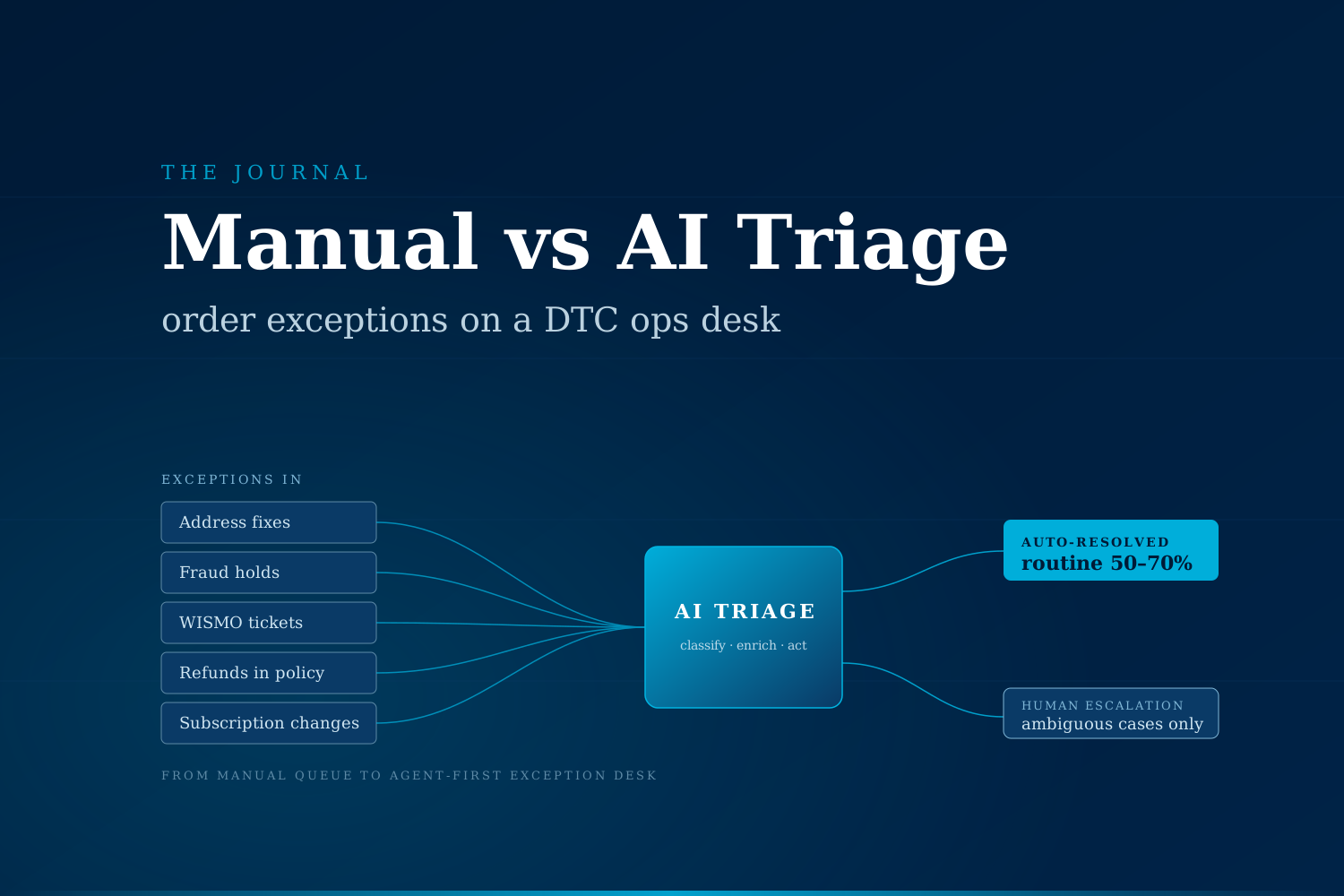
Most DTC operations teams treat order exceptions (wrong addresses, partial shipments, fraud holds, refund disputes, lost packages) as a manual queue that two or three CS reps work through every morning. AI-augmented exception handling moves that queue from human triage to agent triage, with people stepping in only on the genuinely ambiguous cases.
What is an "order exception", and why does it eat ops time?
An order exception is any order whose path deviates from the happy path. At a typical $5M–$30M DTC brand running Shopify or BigCommerce, the recurring categories are predictable:
- Address validation failures and undeliverable shipments
- Fraud and high-risk payment holds
- "Where is my order?" (WISMO) inquiries on delayed or lost packages
- Refund, return, and partial-credit requests
- Subscription pauses, swaps, and skip requests
- Inventory mismatches: overselling, backorders, partial fulfillments
- Carrier claims and damaged-on-arrival reports
Industry data shows the volume is not small. The National Retail Federation's 2023 returns report puts the average online return rate at 17.6% of merchandise sold. Customer-service platform Gorgias has published benchmarks indicating that the majority of DTC support tickets fall into a handful of order-status categories (WISMO, returns, address changes, and refunds), with order tracking alone often the single largest ticket reason. None of these are surprises. They are a structural feature of running a DTC brand.
The cost is not in any one ticket. It is in the cumulative drag of two or three reps, every morning, clicking between Shopify, ShipStation or ShipBob, Gorgias or Zendesk, the fraud queue, Klaviyo notifications, and Recharge, making the same five decisions for the eighty-fifth time that week.
What does manual order exception handling look like today?
Walk the desk of an ops or CS lead at a mid-market DTC brand and the workflow looks roughly the same regardless of category.
A ticket lands. The rep opens the order in Shopify, pulls the customer record, checks order history, opens ShipStation to read the carrier scan history, switches to the fraud tool to see the risk score, then drafts a reply in Gorgias. If the answer involves a refund or an address fix, they click into Shopify Admin again, make the change, return to Gorgias, and confirm with the customer. For a returns case, they consult the return policy, decide whether to issue a label, generate one in Loop or AfterShip Returns, and message the customer.
Time per ticket lands somewhere between three and eight minutes for routine cases, and considerably more for anything involving carrier claims, fraud reviews, or refund disputes. Daily volume runs from fifty exceptions for a small brand to several thousand at the upper end of mid-market.
The pattern that hurts the operation is not the per-ticket time. It is the queue dynamics:
- Volume spikes when the brand spikes. Black Friday, paid-media pushes, and SKU launches all push the queue into the red at exactly the moments when CS speed matters most for revenue.
- Off-hours backlog. Tickets that arrive after the team logs off accumulate overnight. Median first-response time slips into hours.
- Senior CS time gets consumed by tier-one work. The reps who are good at retention conversations and VIP outreach are instead grinding through address corrections.
How does response time actually affect revenue?
Faster CS response times correlate with measurable downstream metrics. Gorgias's published industry benchmarks show that brands with sub-hour first-response times consistently see higher CSAT scores and lower escalation rates than brands measuring response in tens of hours. Zendesk's CX Trends reports have repeatedly highlighted the same pattern across retail more broadly: response speed is one of the strongest predictors of repeat-purchase intent.
When a customer with a fraud-hold question, a wrong-address shipment, or a missing package waits eighteen hours for a reply, two things happen that the support metrics do not capture cleanly. They open a chargeback or PayPal dispute they would not have opened with a faster reply. And they don't repurchase. Both costs land somewhere other than the support team's KPIs, which is part of why manual exception handling is so persistently under-resourced.
Manual desk vs. AI-augmented desk: what changes?
The cleanest way to see the shift is workflow stage by workflow stage. Below is what most $5M–$30M DTC ops desks look like today, side-by-side with what the same desk looks like once an AI agent layer is doing the routine triage.
| Workflow stage | Manual ops desk | AI-augmented ops desk |
|---|---|---|
| Ticket triage and tagging | Rep reads ticket, classifies, routes (2–4 min each) | Agent classifies, tags intent, routes in seconds |
| Address validation and fixes | Rep emails customer, waits hours for reply, updates Shopify | Agent runs validation, proposes a corrected address, confirms with customer, updates the order |
| WISMO inquiries | Rep checks tracking, copies link, drafts reply | Agent fetches tracking + ETA + carrier scan history and replies inline |
| Fraud holds | Rep reviews risk score, IP, AVS; decides release or refund | Agent applies the brand's fraud rules to clear-cut cases; flags ambiguous orders for human review |
| Refunds within policy | Rep checks order, policy, refund amount; sometimes manager approval | Agent applies policy and processes the refund inside a defined rule envelope; escalates exceptions |
| Subscription changes | Rep navigates Recharge, makes change, replies | Customer self-serves through the agent; reps handle only opt-out negotiations |
| Coverage hours | Reps' working hours; queue grows nights and weekends | 24/7; queue stays flat through off-hours |
| Outcome | Median first-response in hours, CSAT volatile under load | Median first-response in seconds for the routine 50–70%, human attention preserved for the rest |
The work does not disappear. Judgment calls (fraud edge cases, refund disputes, retention saves, VIP escalations) still belong to a human. What disappears is the choreography.
What changes for the CS lead and the COO?
The ops leader running an AI-augmented exception desk is not buying a faster ticket-handling robot. They are buying back capacity and visibility.
- Capacity. When 50–70% of routine exceptions auto-resolve, the existing CS team handles a much larger order volume without linear headcount growth. The headcount avoidance is the budget that funds the system.
- Speed during spikes. A Black Friday weekend that used to mean a thirty-six-hour ticket backlog now clears in real time, because the agent layer scales without overtime.
- Structured visibility. Every exception becomes structured data: by reason, by SKU, by carrier, by campaign. Leadership sees patterns that were previously buried inside a Gorgias inbox: which carrier is responsible for half the WISMO volume, which SKU drives the most damage claims, which paid-media campaign correlates with elevated fraud risk.
- Off-hours coverage. Customers in non-US time zones, or shopping at 11 p.m., get the same response speed as a customer messaging at 2 p.m. on a Tuesday.
- Senior CS time goes to retention. The most expensive and most experienced reps are the ones with the highest impact on lifetime value when they are doing VIP outreach, recovery on at-risk customers, and review-response work. They cannot do that work while triaging address fixes.
When does this make sense for a DTC brand?
Not every brand is at the volume where AI exception handling pays for itself. The honest answer to "should we be doing this?" is bounded by a few signals.
It is usually a fit when:
- Daily order volume is above ~50 orders per day, with at least one full-time CS rep on the desk.
- More than 20% of customer touches are tier-one categories: WISMO, address fixes, refund-within-policy, subscription changes.
- The CS team is spending half their week or more on tier-one work, which means VIP and retention work is being deferred or skipped.
- The stack is on standard rails (Shopify or BigCommerce plus ShipStation or ShipBob plus Gorgias / Zendesk / Front plus Klaviyo plus Recharge or similar), so the integration work is not bespoke.
It is usually not a fit yet when:
- The brand is pre-product-market-fit at under $1M GMV and the volume cannot justify the build.
- Fulfillment logistics are still being figured out and the rules under which an agent should act are themselves changing month to month.
- The brand sells highly bespoke or made-to-order products where each exception is materially different and human judgment is the product.
Three signs an exception desk is costing more than it looks
- Median first-response time is measured in hours, not minutes, on routine WISMO tickets. Routine tracking questions are the cheapest possible win for a faster response. If those are slow, retention metrics are leaking quietly elsewhere.
- The CS team's quarterly headcount conversation is always "we need one more rep." Linear headcount growth on a desk that is mostly handling repeatable categories is a sign the ops architecture has not changed since the brand was a quarter of its current size.
- Leadership cannot answer "what is our top exception reason this month?" from a dashboard. If the answer requires someone to spend a Friday afternoon re-reading tickets in Gorgias, the operation is running on inboxes, not on data.
Most ops leaders we talk to see at least two of these. The cost is real, and like most operational drag at this stage, it is the kind that is easy to live with because it never lands as a single visible line item.
Curious what an AI-augmented exception desk would look like on your stack?
We run a completely free automation audit for DTC ops teams that want a second opinion before committing to anything. No slide deck, no procurement gauntlet. We map your current exception flow, look at where the queue actually leaks, and show you what the same desk looks like with an AI triage layer on top.