The Hidden Cost of a Manual Freight Sales Desk
Where freight broker sales desks quietly lose six figures a year, and what the same desk looks like once AI handles the repetitive 80%.
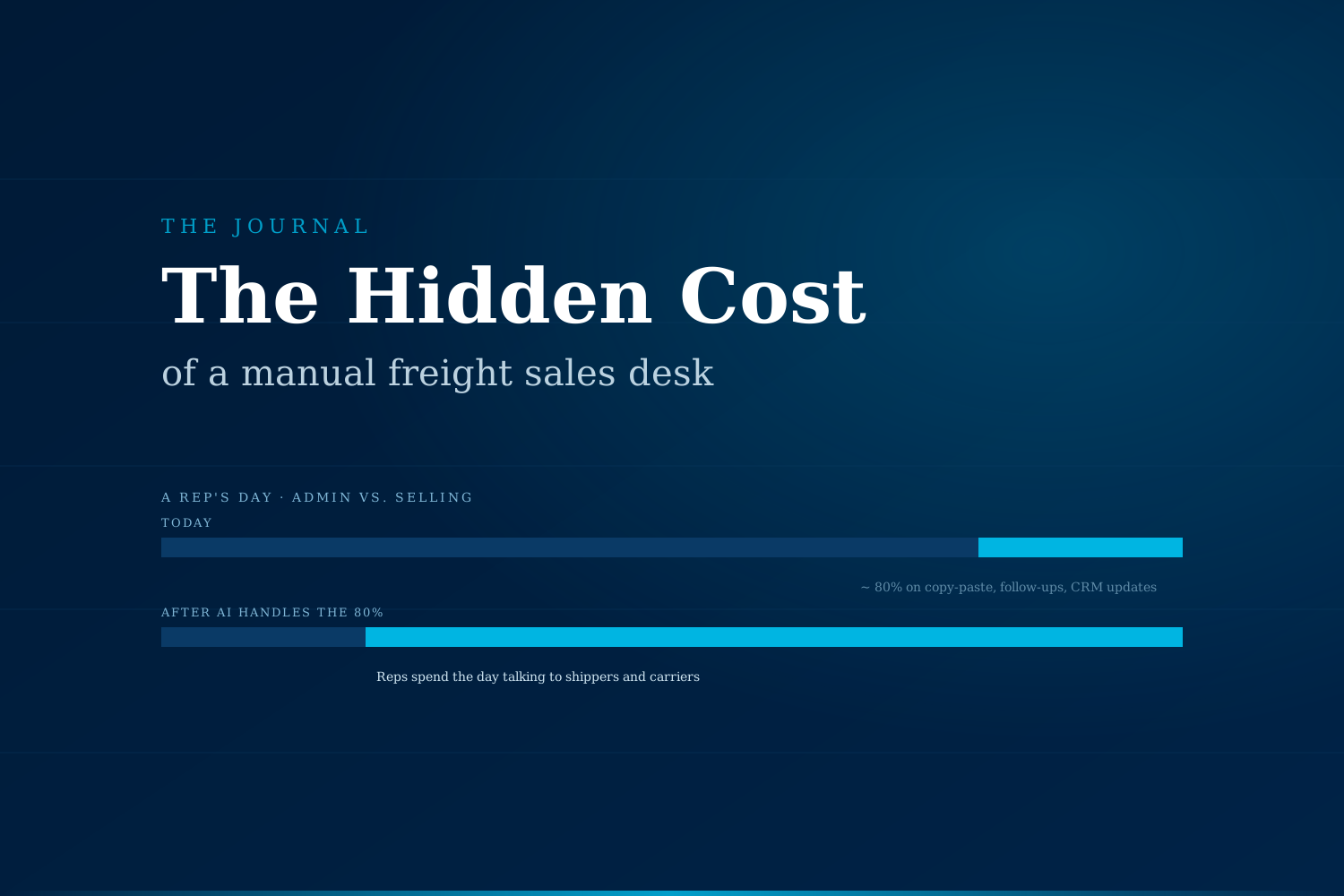
A four-person freight sales desk running on email, spreadsheets, and a CRM nobody fully trusts is quietly losing six figures a year. Not in salaries, but in slow quotes, dropped follow-ups, and reps doing $15-an-hour work at $80,000 base. Here is where the money actually disappears, and what the same desk looks like once AI handles the repetitive 80%.
What does a "manual" freight sales desk actually do all day?
Watch a typical day. An RFQ lands at 9:14 AM. The rep finishes the quote they were already building, opens the email at 9:42, pastes lane and weight into a rate-check tab, copies the result into a quote template, sends it back at 9:58. Forty-four minutes for one reply.
Multiply that across three to five hundred RFQs a month per rep (plus carrier sourcing, follow-ups, CRM updates, and reactive Slack threads) and the workday is mostly typing and waiting. Selling, the thing reps were hired for, is what happens in the gaps.
Where does the money quietly disappear?
Five places. None of them show up cleanly on a P&L, which is part of the problem.
1. Slow first response. Research from Harvard Business Review found leads contacted within five minutes are 21x more likely to qualify than those contacted in 30. Most freight desks measure response time in hours. The shipper who got your quote at 4 PM already booked the load with the broker who quoted at 9:20 AM.
2. Quote latency. A broker who returns a quote in six minutes wins lanes a broker quoting in six hours never sees. The math on that gap, repeated across a year, is enormous, and almost no broker tracks it.
3. Follow-up that stops at touch one. Industry surveys consistently report that around 44% of B2B sales reps give up after a single follow-up, and most leads receive only one or two touches before going silent. Each one is a paid-for lead that was almost ready, and went to a competitor.
4. CRM that lies. Reps log what's convenient, not what happened. Pipeline reviews are based on data the rep half-remembers from Tuesday. Forecast becomes fiction.
5. Margin leakage. Without time to evaluate which lanes are actually profitable, every load gets chased equally. The reps with the highest activity often have the worst margin. They are quoting the easy stuff fastest.
The "before" picture: what 4 reps and spreadsheets really cost
Take a typical desk: four reps, base around $70K, fully loaded close to $90K each. That is roughly $30,000 a month in compensation.
Industry studies of B2B sales productivity put 60–65% of a rep's day on non-selling activity. Conservatively call it 50% on truly repeatable work: pasting, formatting, checking, logging.
That is $15,000 a month of compensation funding work that does not need a human to do it.
Annualized: $180,000 a year of comp going to copy-paste, before you even count the lost-revenue side of slow quotes and dead follow-ups. For most owner-operated brokerages, that is the cost of the next two reps you keep saying you will hire.
What the desk looks like once AI handles the repeatable 80%
Same four reps. Different day.
| Workflow | Manual desk | AI-augmented desk |
|---|---|---|
| First touch on inbound RFQ | 30–120 minutes | Under 5 minutes, automatically |
| Quote drafted | Rep builds from scratch | Drafted with rate context, rep approves |
| Follow-up cadence | One or two touches, then gone | Sequenced until reply or formal close |
| CRM updates | "Later" (often never) | Logged from emails and calls automatically |
| Lane / margin scoring | Gut feel | Surfaced before the rep quotes |
| What reps actually spend time on | Typing | Talking to shippers and carriers |
The point is not that humans get replaced. The point is that humans stop doing work that did not require a human to begin with.
What does the desk's P&L start to look like?
Three doors open once the repeatable layer is automated.
Door 1: same headcount, more throughput. Four reps now respond to every RFQ within minutes, follow up until the lead converts or formally dies, and have time to actually negotiate. Pipeline doubles before you hire anyone.
Door 2: same throughput, leaner desk. Two reps plus AI cover what four did manually. The other two get redeployed into account management, carrier development, or simply off the bill. Six-figure annual savings.
Door 3: different hires. You stop hiring SDRs to chase volume and start hiring closers, lane specialists, or account managers, the roles that compound margin. Your headcount looks more like a revenue team than a data-entry team.
Most brokerages we talk to take some version of Door 1 first, then Door 3 in the second year.
Three signals worth checking on your own desk
A few patterns we see across freight sales teams. None of these are unusual; most desks have at least one. They are useful prompts for a quick internal audit.
- You cannot say, without checking, your average inbound-RFQ response time this week.
- The top rep is also the rep who answers the most emails at 7 AM and 10 PM.
- Pipeline reports change meaningfully depending on which rep you ask.
If one or two of these feel familiar, the manual layer is likely costing more than the salaries running it.
The honest part: AI cannot run your sales desk alone
Negotiation, lane intuition, the relationship with the shipper who calls you for a favor at 5 PM. Humans win those. Anyone telling you AI replaces the desk is selling something. The leverage is in carving off the repeatable 80% so your humans can spend their day on the 20% that compounds.
That is the difference between a sales desk that scales with headcount and one that scales with revenue.
If any of this resonates, we offer a completely free automation audit for freight and logistics sales desks. We map your inbound response times, follow-up coverage, and CRM accuracy, and quantify the recoverable cost, typically between $120K and $250K in the first year. No slide deck, no commitment, just a clear picture of what is and isn't worth automating on your specific desk.